
Spain electricity bills to rise again from June as VAT returns to 21%
Spanish households face higher electricity and gas bills from 1 June 2026 as temporary energy tax cuts end. VAT returns to 21%, while the Special Electricity Tax also rises back to its normal level.
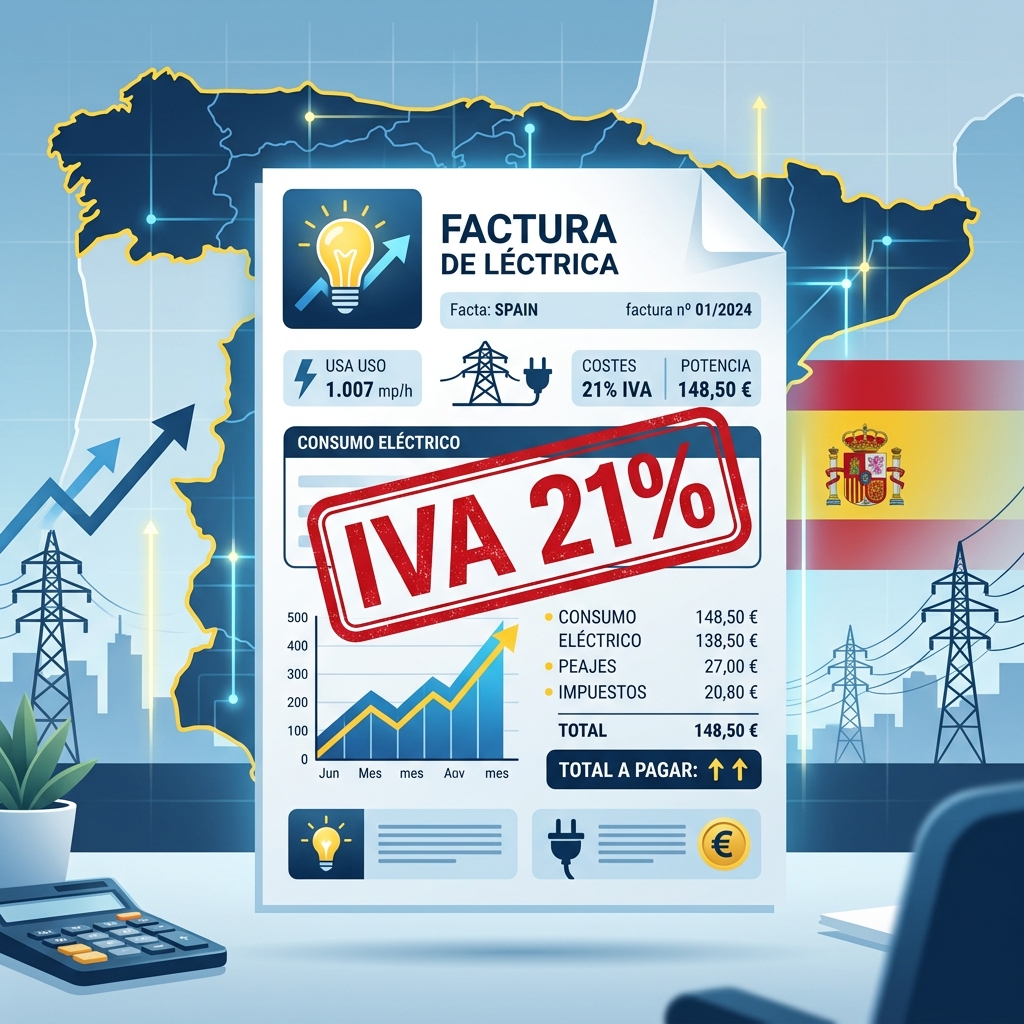
Spain electricity bills to rise again from June as VAT returns to 21%
From 1 June 2026, Spanish households will lose the temporary tax relief on electricity and gas bills, meaning many customers will see higher bills even if their actual energy use stays the same.
Spain’s temporary reduction in VAT on electricity and gas is coming to an end earlier than many households expected. From 1 June 2026, VAT on electricity and natural gas will return to the standard 21% rate, after being temporarily reduced to 10% under the government’s emergency energy measures.
The change follows confirmation that energy prices moderated in April. Under the rules of Royal Decree-Law 7/2026, the reduced VAT rate was due to apply until 30 June 2026, but only if the relevant energy price indicators continued to justify the support. The Spanish Tax Agency made clear that the June application of the reduced VAT rate was conditional on the evolution of the CPI for electricity, gas and fuels.
That condition has now triggered a partial rollback. According to Spanish media reports, the VAT reduction for electricity, natural gas, pellets, briquettes and firewood will end from 1 June, while some fuel-related support measures will remain in place until at least the end of June.
What exactly is changing?
From 1 June 2026:
- Electricity VAT returns from 10% to 21%.
- Natural gas VAT returns from 10% to 21%.
- The Special Electricity Tax returns from 0.5% to its normal rate of 5.11269632%.
The Spanish Tax Agency confirmed that the Special Electricity Tax had been temporarily reduced from 5.11269632% to 0.5% under the same emergency package.
The reduction applied to electricity contracts with a fixed contracted power of less than 10 kW, as well as vulnerable consumers receiving the social bonus. It also applied to natural gas, briquettes, pellets and firewood.
How much more could your bill cost?
For electricity customers, this is not just an 11-point VAT increase. The Special Electricity Tax is also returning to its normal level, so the real impact can be higher than many people expect.
As a simple example:
| Example electricity bill subtotal | With reduced taxes | From 1 June 2026 | | : | Energy and power subtotal | €100.00 | €100.00 | | Special Electricity Tax | €0.50 | €5.11 | | VAT | 10% | 21% | | Final amount | approx. €110.55 | approx. €127.19 |
In this simplified example, a €100 electricity subtotal rises by around €16.64, simply because the tax treatment changes.
For natural gas, the calculation is simpler. A €100 gas subtotal currently becomes around €110 with 10% VAT. From June, the same subtotal becomes €121 with 21% VAT. That is an increase of €11 on every €100 of taxable gas charges, before considering any supplier price changes.
Why is this happening?
The government introduced the temporary tax reductions as part of a wider response to energy price pressure linked to international instability and the crisis in the Middle East. The Spanish Tax Agency described the measures as “extraordinary and temporary”, with the 10% VAT rate originally applying from March 2026 until 30 June 2026, subject to CPI conditions.
The latest inflation data confirmed that energy prices had moderated enough for the electricity and gas reductions to expire. El País reported that electricity and gas support will be withdrawn from 1 June, while fuel support continues because fuel prices still exceeded the threshold set in the decree.
Cadena SER also reported that the decision follows April inflation data, with general inflation moderating to 3.2%.
Why this matters for households in Spain
The uncomfortable part is that your bill may rise even if your consumption does not.
Many households look at the headline price per kWh and assume that is the whole story. It is not. A Spanish electricity bill includes several layers:
- Energy consumption, charged per kWh.
- Contracted power, charged per kW per day.
- Electricity tax.
- Meter rental.
- VAT.
- Optional services or maintenance add-ons.
When VAT and electricity tax rise, the final bill rises across most of the bill, not just the energy you consume.
That means a customer on a decent tariff can still see a noticeable increase from June. A customer already paying an expensive legacy tariff will feel it even more.
Customers on old contracts will be hit hardest
The VAT increase applies widely, but the real damage will be worst for households already paying too much for electricity.
At WeswitchSpain, we still regularly see customers paying old or poorly renewed electricity prices, sometimes far above the rates available on newer fixed or indexed tariffs. In those cases, the tax rise simply makes an already expensive bill worse.
This is exactly why June is a good time to check your electricity contract.
If your current tariff is already expensive, the VAT change is not something you can control, but your underlying price per kWh may be. Reducing the base tariff softens the effect of higher taxes because VAT is calculated on top of the bill.
What should you check on your electricity bill?
Before switching, check these four things:
- Your price per kWh: Look at what you are paying for P1, P2 and P3 energy periods, or whether you are on a flat fixed price.
- Your contracted power costs: Many customers focus only on kWh prices, but the fixed daily power charge can add up. Spain has two power periods, usually shown as P1 and P2 potencia.
- Extra services: Maintenance plans, insurance products and “servicios adicionales” can quietly add €5 to €15 per month.
- Whether you have solar, an EV or high night usage: The best tariff depends on your usage pattern. A household with solar panels needs a different comparison from someone charging an electric car overnight.
Can switching supplier avoid the VAT rise?
No. The VAT increase is a tax change, so every supplier has to apply it.
But switching can still reduce the underlying cost of your electricity.
Think of it like this: VAT is added on top of your bill. If the base bill is too high, the VAT hit is larger in euro terms. If you reduce the base cost, the tax is still there, but you are paying tax on a lower amount.
That is why comparing tariffs now makes sense.
Are you overpaying for electricity?
Upload your last bill. Our AI will scan every line to find your cheapest possible tariff in Spain.
What about solar customers?
Solar households should pay close attention to this change.
If you have solar panels, your imported electricity from the grid will become more expensive from June because of the higher tax rate. That makes self-consumption more valuable, especially during daylight hours.
But export compensation also matters. Some solar tariffs offer better export rates, virtual battery options or solar-specific conditions. The cheapest standard tariff is not always the best solar tariff.
For solar users, the key question is not just “what is the cheapest price per kWh?” It is: How much do I import, how much do I export, and how is my surplus valued?
What should households do now?
The tax increase is not optional, but overpaying for electricity is.
Before the June change appears on your bill, it is worth reviewing your current contract and comparing it against newer tariffs. This is especially important if:
- You have not changed supplier in the last 12 months.
- You are with a large legacy supplier.
- You are paying more than around 10 to 13 cents per kWh before taxes.
- You have solar panels.
- You charge an electric vehicle.
- You have high summer air conditioning use.
- You see extra services or maintenance charges on your bill.
Final word
Spain’s return to 21% VAT on electricity and gas will make bills more expensive from June 2026. For electricity customers, the return of the Special Electricity Tax makes the increase even more noticeable.
You cannot avoid the tax change, but you can make sure you are not paying too much underneath it.
At WeswitchSpain, we compare real electricity bills against current tariffs, including energy prices, contracted power, solar export and fixed charges. Upload your bill and we will show whether you could save money before the higher tax rate starts to bite.