How to Read a Spanish Electricity Bill in 2026
Understand Potencia, P1 P2 P3 pricing, taxes, solar export compensation and every charge on your Spanish electricity bill.
Quick Answer
A Spanish electricity bill is normally made up of five main parts:
- Contracted power (Potencia)
- Electricity consumed (kWh)
- Electricity tax
- Meter rental
- VAT (IVA)
Potencia
Fixed daily charge
Energy
The electricity you consume
Taxes
Government taxes and VAT
Meter
Monthly rental charge
Solar
Export credits if applicable
Spanish Electricity Bill at a Glance
| Question | Answer |
|---|---|
| What is Potencia? | Your fixed daily power charge. |
| What is P1? | Peak electricity pricing period. |
| What is P2? | Shoulder electricity pricing period. |
| What is P3? | Off peak electricity pricing period. |
| What is CUPS? | Unique supply point number. |
| Do solar owners get paid? | Usually through bill credits. |
| Can I lower Potencia? | Often yes. |
| Best way to check savings? | Upload your bill. |
Is Your Electricity Bill Correct?
Upload your latest electricity bill and we will check:
[Pages.spanishBillExplained.explainer.mainTitle]
[Pages.spanishBillExplained.explainer.mainSubtitle]
[Pages.spanishBillExplained.explainer.default.title]
[Pages.spanishBillExplained.explainer.default.desc]
Fast Select
How to Read a Spanish Electricity Bill
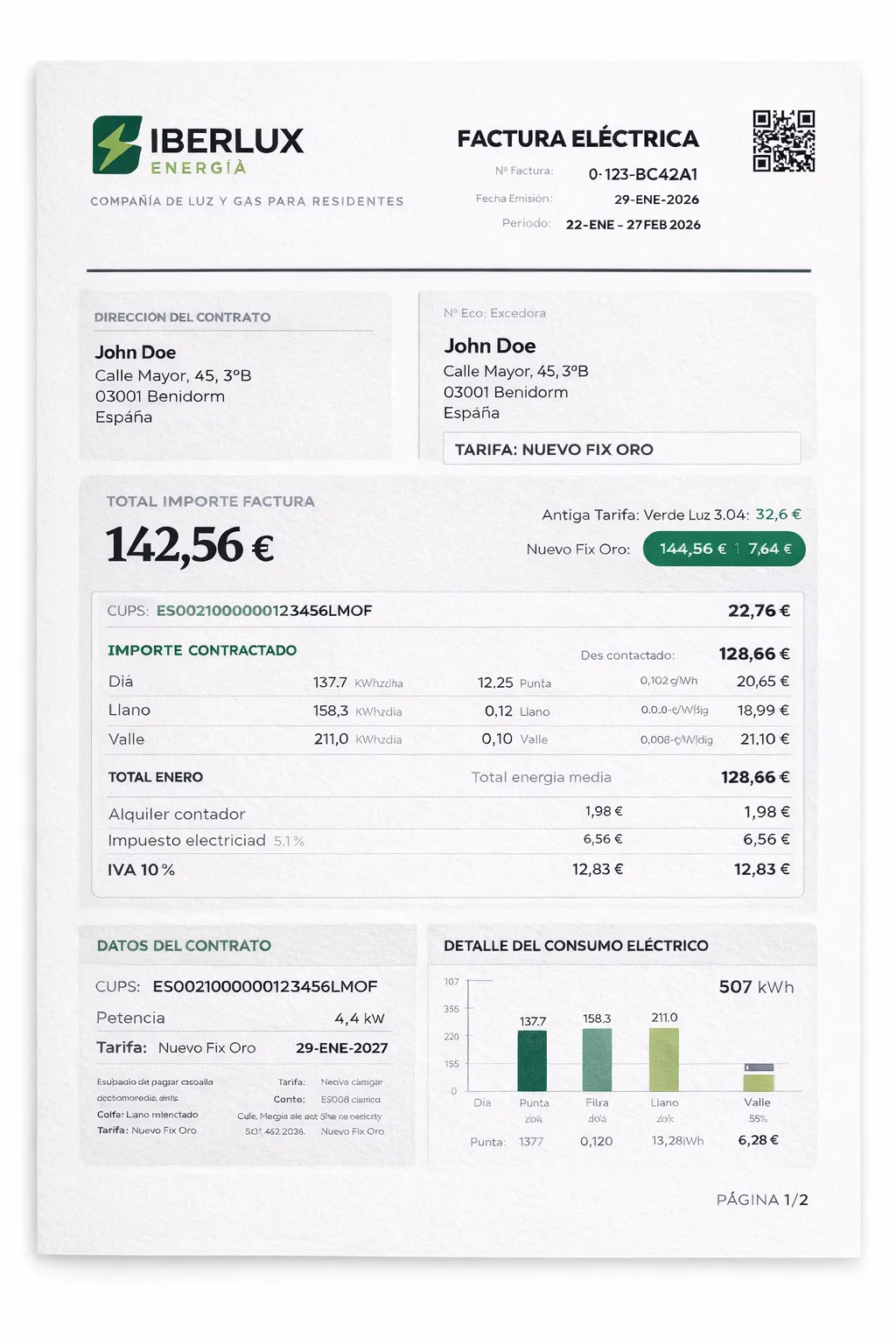
A Spanish electricity bill may look complicated at first, but most bills follow the same structure. The most important sections are:
- Contract holder
- Supply address
- CUPS number
- Contracted power
- Electricity consumption
- Tariff prices
- Taxes
- Solar export compensation
- Total amount due
Once you understand these sections, comparing suppliers becomes much easier.
Spanish Electricity Bill Charges Explained
Contracted power
The fixed daily fee based on the maximum power your home can draw. You pay this even if you use no electricity.
Electricity consumption
The cost of the electricity you actually use, measured in kWh. This varies depending on your usage and your tariff's unit price.
Electricity tax
A government tax applied to both your contracted power and electricity consumption.
Meter rental
A small monthly fee paid to the distributor for renting the smart meter, unless you own it.
VAT (IVA)
Value Added Tax applied to the total amount of the bill, including the other taxes.
Extra supplier services
Additional services like maintenance plans or insurance that some suppliers add to the bill.
Solar export credits
If you have solar panels, this section shows the compensation for the excess energy you sent back to the grid.
Why is My Spanish Electricity Bill So High?
There are many reasons why electricity bills in Spain can be expensive. The most common are:
- Contracted power higher than necessary
- Expensive fixed tariff
- Old loyalty tariff
- Solar export compensation that pays poorly
- High air conditioning use
- Electric water heating
- Electric vehicle charging
- Additional services added by the supplier
We regularly find customers paying significantly more than necessary because they have never compared tariffs after moving to Spain or installing solar.
Check My BillWhat is Potencia?
Potencia is the maximum amount of electricity your home can draw at any one time. Think of it as the width of a water pipe. The bigger the pipe, the more electricity can flow at once. Even if you use very little electricity, you still pay for that pipe every day. Many homes in Spain pay for more contracted power than they actually need. Reducing Potencia can sometimes save money without changing suppliers.
| Apartment | 3.45 kW |
| Small house | 4.6 kW |
| Medium house | 5.75 kW |
| Large house | 6.9 kW |
| Pool + EV | 7 to 10+ kW |
What are P1, P2 and P3?
Spanish households on 2.0TD tariffs pay different electricity prices depending on the time of day.
P1
Peak period. Most expensive.
P2
Shoulder period. Medium price.
P3
Off peak period. Usually the cheapest.
The exact times vary depending on weekdays, weekends and public holidays. This system encourages consumers to move electricity usage to quieter periods.
Examples of appliances to run in off-peak hours:
- EV charging
- Pool pumps
- Dishwashers
- Washing machines
- Water heaters
Weekday Timeline (Monday to Friday)
Weekend & National Holidays Timeline
P3 / Valle (Off-Peak)
00:00 - 08:00 Weekdays, All Day Weekends & Holidays
P2 / Llano (Mid-Peak)
08:00-10:00, 14:00-18:00, 22:00-24:00 Weekdays
P1 / Punta (Peak)
10:00-14:00, 18:00-22:00 Weekdays
Why do I pay two power charges?
Spanish electricity bills usually include two contracted power charges, one for peak hours (P1) and one for off-peak hours (P2). Together they make up the Potencia section of your bill.
Why do I have three electricity prices?
Most domestic tariffs in Spain use three energy periods called P1, P2 and P3. Electricity costs more during peak hours and less during off-peak hours.
What is the CUPS Number?
The CUPS number is the unique identifier for your electricity supply point. Think of it as: The house’s electricity passport. Every property has its own CUPS number. If you switch suppliers, the CUPS normally stays the same. It is often required when:
- changing supplier
- moving house
- activating solar export compensation
- changing contracted power
Spanish Electricity Bills for Foreigners and Expats
Many foreigners living in Spain are surprised by the structure of their electricity bill. Unlike some countries, Spanish bills separate contracted power, energy consumption, taxes and solar export compensation into different sections. Understanding these charges is important because changing supplier or reducing contracted power can sometimes save money without changing your lifestyle. If you’ve recently moved to Spain or inherited an existing tariff, uploading your bill is the easiest way to check whether it is competitive.
Upload Your BillSolar Export Compensation
If your property has solar panels, your bill may include export compensation. This is often called: Compensación de Excedentes. When your solar panels produce more electricity than you consume, the excess energy is exported to the grid. Your supplier then applies a financial credit to your bill. Spain does not normally use traditional net metering. The value of exported electricity depends on:
- supplier
- tariff
- market prices
- virtual battery rules
Spanish Electricity Bill Glossary
Alquiler de contador
Meter rental fee charged by the distributor.
Cargos
Regulated system charges included in your bill.
Comercializadora
Your electricity supplier who issues the bill.
Compensación de excedentes
Financial compensation for excess solar energy exported to the grid.
CUPS
Universal Supply Point Code, the unique ID for your property's connection.
Distribuidora
The company that owns the network and meter in your area.
ICP
Power Control Switch, now integrated into smart meters, that cuts power if you exceed your Potencia.
IVA
Value Added Tax applied to the electricity bill.
kWh
Kilowatt-hour, the unit used to measure electricity consumption.
P1
Peak period (Punta) for either energy or power.
P2
Shoulder period (Llano) for energy, or off-peak for power.
P3
Off-peak period (Valle) for energy.
Peajes
Access tolls paid for using the electricity network.
Potencia
Contracted power capacity, measured in kW.
PVPC
The government-regulated electricity tariff.
Tarifa fija
A fixed-price electricity tariff.
Tarifa indexada
A tariff linked to the wholesale market price.
Virtual battery
A system where excess solar credits can be saved for future bills.
Frequently Asked Questions
How do I read a Spanish electricity bill?
Start by identifying your contracted power (Potencia), your total energy consumption in kWh, and your tariff's unit prices. Check if you are paying for extra services or if your Potencia is higher than you need.
Why is my Spanish electricity bill so high?
High bills are often caused by having an expensive tariff, too much contracted power, electric water heating, high AC usage, or paying for additional maintenance services you do not use.
What is Potencia?
Potencia is the maximum electrical capacity of your home. You pay a fixed daily fee for it regardless of how much electricity you use.
What is P1 P2 P3?
These are the three time periods used for electricity pricing in Spain. P1 is the expensive peak period, P2 is the medium-priced shoulder period, and P3 is the cheap off-peak period.
What is a CUPS number?
The CUPS number is a unique 20 or 22 character code starting with 'ES' that identifies your specific supply point on the Spanish electricity grid.
Can I reduce contracted power?
Yes, you can usually reduce your Potencia. Most suppliers allow you to change it once a year. Reducing it lowers your fixed daily costs, but setting it too low will cause your power to trip.
Does Spain use net metering?
No, Spain typically uses 'Compensación de Excedentes', where exported solar energy is credited to your bill financially, rather than a 1:1 energy exchange.
How does solar export compensation work?
When your solar panels generate electricity you don't use, it is exported to the grid. Your supplier pays you a set rate per kWh, which appears as a discount on your energy bill.
Can solar export prices be negative?
Yes, if you are on an indexed tariff, wholesale market prices can drop to zero or become negative, meaning your exported solar energy has no value or could technically incur a cost, though most suppliers floor it at zero.
What is a virtual battery?
A virtual battery is a service offered by some suppliers where excess solar credits that exceed your energy consumption can be saved in a virtual 'wallet' to discount future bills.
What is PVPC?
PVPC stands for Precio Voluntario para el Pequeño Consumidor. It is the government-regulated electricity tariff where prices change every hour based on the wholesale market.
How do I know if my tariff is competitive?
The most reliable way is to upload your latest electricity bill to a comparison service. They will analyze your exact usage, Potencia, and current prices to calculate true potential savings.
Why do I pay two power charges?
Spanish bills split contracted power into two periods: P1 for peak hours and P2 for off-peak hours. You can choose to have different power levels for each.
Why do I have three electricity prices?
Domestic 2.0TD tariffs have three pricing periods for energy consumption (P1 peak, P2 shoulder, P3 off-peak) to encourage usage during periods of lower grid demand.
Can I change my Potencia?
Yes, you can contact your supplier to request a change in your Potencia. You will be charged a small fee by the distributor, especially if you are increasing it.
Still Not Sure if Your Bill is Good?
Our bill checker analyses your tariff, contracted power, solar export compensation and annual consumption to see if you could save money.